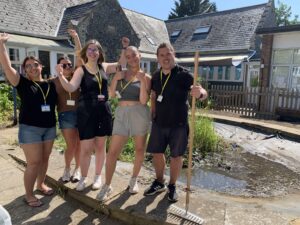


I have spent twenty years helping businesses get their people outside to do something meaningful for the environment. Tree planting in November drizzle. Clearing invasive species on a bright spring morning. Watching a group of colleagues who barely knew each other at nine o’clock become a proper team by lunchtime. And in all that time, the thing that has never changed is the moment people look back at what they have done and realise the difference they have made.
That moment is what environmental volunteering is really about. Not a policy document or an ESG framework, but a person seeing with their own eyes that their time and effort changed something real. Something you can photograph, point to and feel proud of.
World Environment Day on 5 June always brings this conversation back into focus, but the businesses that get the most from environmental volunteering are not thinking about it as an awareness day activity. They are building something consistent, something their people genuinely want to be part of, and something that delivers real, measurable value over time.
Commitment on paper versus commitment in practice
There is a version of corporate environmental commitment that lives entirely in documents, from net zero targets and sustainability strategies through to supply chain policies. All of it important, but none of it something your employees can see, touch or feel part of.
And then there is the version where a team of twenty people spends a day restoring a wetland and by the end of it the space looks completely different. Where employees who came along slightly reluctantly go home and tell their families what they did. Where a local charity gets six months worth of practical work completed in a single afternoon.
That second version makes the commitment human. It gives it a face, a story and a tangible outcome. And increasingly, that is what stakeholders, investors and communities are looking for, not just evidence that an organisation cares about the environment, but evidence of what it has actually done. Environmental volunteering bridges that gap in a way that very few other activities can, and you can see a good example of that in the tree planting work we have supported in local communities, where the outcomes are visible from day one and keep growing for years afterwards.
The impact goes deeper than a good day out
For employees, a well-run environmental volunteering day does something genuinely difficult to replicate in an office or a training room. Working with your hands, alongside colleagues you might not normally spend time with, towards a goal you can see right in front of you. People come back with more energy, stronger connections and a renewed sense of purpose. The wellbeing benefits are real and they last well beyond the day itself.
For communities, the impact is immediate. Green spaces that were neglected become places people want to use. School grounds that were bare and uninviting become outdoor classrooms, as you can see in this project supporting young people through outdoor environments. Riverbanks cleared of waste and invasive species become habitats where wildlife returns. These are not abstract outcomes. They are places that local people experience every single day.
The best programmes we have delivered have done all of this at once. We have seen businesses transform neglected land into green spaces that communities genuinely use, and others create outdoor learning spaces in schools that children benefit from for years. The cumulative effect of that kind of consistent, well-designed activity is significant and it is all measurable.
Why this matters for ESG reporting and the UN Sustainable Development Goals
Environmental volunteering generates genuine, reportable evidence. How many trees were planted, how many hectares of habitat were restored, how many kilograms of waste were removed, how many hours were contributed and how many employees took part. That evidence maps directly to the UN Sustainable Development Goals that matter most in this space: SDG 13 on climate action, SDG 14 on life below water and SDG 15 on life on land. For businesses building their ESG reporting, that is a genuinely useful thing.
But the stories behind the data are what make it land. A charity describing how a single day of volunteer support completed a restoration project they had been trying to resource for two years. Employees realising they had just cleared a stretch of riverbank that was choking a local wildlife habitat. A school receiving an outdoor learning space that will shape how hundreds of children connect with nature for years to come. Numbers tell you what happened. Stories tell you why it mattered.
Ten ways to get your teams involved
The best programmes offer genuine variety, because people will not all want to do the same thing and that is exactly the point. Here are ten activities that consistently work well.
- Work with charity partners to plant trees in local communities that need more green cover. (See an example)
- Clear invasive plants and restore areas so native habitats can recover and thrive.
- Take part in river, canal or beach clean-ups to remove waste and protect local wildlife.
- Help create or maintain outdoor spaces for schools. (See how this works)
- Work with pupils to build bird boxes, bug hotels or pollinator areas that support local biodiversity.
- Support woodland or park maintenance, including clearing, planting and upkeep of green spaces.
- Get involved in community growing projects, creating and maintaining gardens or food-growing spaces.
- Run environmental workshops in schools on biodiversity, sustainability and the natural world.
- Contribute to biodiversity or wildlife tracking online through citizen science programmes.
- Use professional skills to support environmental charities in communications, research, data or digital.
And for those who cannot or do not want to spend a day outside, digital and skills-based volunteering opens up participation considerably. Employees can map green spaces, review wildlife data or support environmental charities with their professional expertise, all of which delivers genuine value. You can explore how that works in practice here.
What makes a programme actually work
After twenty years of designing and delivering environmental volunteering programmes, I have a pretty clear view of what works and what does not. And honestly, it is rarely the complicated stuff that makes the difference.
The activity has to be grounded in real need, designed with the people who know the land and the community. Activity that is not will rarely deliver anything worth talking about, and employees can tell the difference faster than you might expect.
The experience has to be well run. When people arrive and find a well-organised day where they understand what they are doing and why it matters, they engage fully and come away feeling it was worthwhile. That is what determines whether they want to do it again.
And consistency is what turns a programme into something that becomes part of the culture. The organisations that see the deepest impact are the ones that make environmental volunteering a regular, valued part of how they operate, not something that happens once a year and gets forgotten about. That is when it stops feeling like a corporate initiative and starts feeling like part of who you are.
The part no policy document can do
The businesses that do environmental volunteering well are not doing it because they feel they have to. They are doing it because they have seen what happens when their people get outside together, work on something that genuinely matters and come back changed by it. That kind of experience builds engagement, strengthens culture and gives organisations something real and credible to talk about.
If you are building an environmental volunteering programme, or looking to strengthen what you already have, we would love to talk. You can explore our approach here.
For more on World Environment Day 2026, visit worldenvironmentday.global
FAQs
1. What can companies do for World Environment Day 2026 to make a real impact?
Companies can make a real impact on World Environment Day 2026 by focusing on practical action that involves their people directly. That might include environmental volunteering such as tree planting, habitat restoration, river or beach clean-ups, or improving local green spaces. With The Big Help Out running across the same weekend and 2026 recognised as the International Year of Volunteers, there is real momentum behind community action right now, and a natural opportunity for organisations to be part of it in a visible, meaningful way.
The key is not to treat World Environment Day as a one-off event, but as a starting point. The organisations that see the most value use it to build or strengthen ongoing environmental volunteering programmes that deliver consistent impact over time.
Well-designed programmes ensure activity is grounded in real environmental need, easy for employees to take part in and capable of delivering clear, measurable outcomes.
2. How does employee volunteering support environmental sustainability?
Employee volunteering supports environmental sustainability by turning commitments into visible, practical action. Instead of relying on policy alone, it enables organisations to contribute directly to environmental outcomes, whether that is restoring habitats, reducing waste, supporting biodiversity or improving local environments.
It also plays an important role in engaging employees. People can see what has been done, understand the impact and take part in delivering it. That combination of action and engagement strengthens environmental performance and supports ESG reporting with activity that can be clearly evidenced.
3. What is the most effective way to organise environmental volunteering for employees?
The most effective environmental volunteering programmes are structured, well-managed and built around real community and environmental need.
That means designing a mix of opportunities, from hands-on outdoor activity to skills-based and digital volunteering, so more employees can take part. It also requires good facilitation, clear organisation on the day and a consistent approach over time, rather than relying on one-off events.
Organisations that do this well create programmes that are easy to access, deliver meaningful environmental impact and build strong employee engagement, while also providing a clear view of what has been achieved.