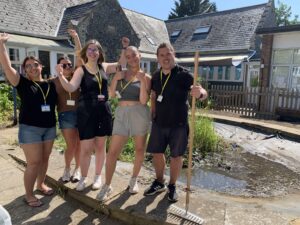

There’s a piece of feedback we hear regularly from people who have taken part in our corporate volunteering programmes. It’s not typically written on the feedback form, but tends to come out in conversation, a little unexpectedly, often from someone who has been at their company for years.
“For the first time, I felt like I actually belonged here.”
This feedback says something really important about what belonging at work really feels like when you find it.
Fitting in at work is not the same as belonging
Most organisations put genuine effort into inclusion. The policies are in place, the values are visible, and by most measures the workforce is doing fine. People get on well enough, the work gets done, and very few are particularly unhappy.
But fitting in and genuinely belonging are two different things. Fitting in means adapting yourself to the culture around you. Belonging means the culture accepts you as you actually are. That distinction matters more than most organisations realise because it surfaces in ways that are hard to pin to a single cause: a reluctance to speak up in meetings, a tendency to keep personal life firmly separate from work, a feeling of being slightly on the edge of things without being able to say exactly why.
The good news is that belonging can be built, and one of the most effective ways is corporate volunteering.
What happens when employees volunteer together
Belonging is an experience, not a policy. You cannot communicate it into existence or train people to feel it. It comes from moments of genuine connection, from discovering that a colleague you have barely spoken to is someone worth knowing, from doing something useful alongside people you would never normally work with.
That is exactly what corporate volunteering creates. When you put people side by side on a task that has nothing to do with their job title, hierarchy loosens. The director who cannot work a paint roller and the graduate who has never held one are equally useful. That levelling creates a kind of conversation that is genuinely harder to have in a meeting room. People discover each other, and those discoveries travel back to work with them.
We saw this recently with Emma, who works in procurement at a large IT company. She had been there four years, worked remotely most of the week, and had barely spoken to anyone outside her immediate team. She came along to a volunteering day reluctantly, she admits, mostly because her manager mentioned it twice.
By lunchtime she was building raised beds in a community garden with a senior technology director she had exchanged maybe three emails with in four years.
“He knew nothing about spreadsheets and I knew nothing about AI strategy,” she told us afterwards. “But we both knew how to use a screwdriver. I went back to work feeling like I actually knew someone at the top of this company. Like I existed to them.”
Six months later, Emma joined a cross-functional working group she would never have put herself forward for before. She traces it back to that garden.
The volunteering ripple effect
The connection Emma describes is not unusual, and it scales.
A few months ago we ran a skills-based programme for a financial services client, bringing together both junior colleagues, middle managers and people at director level from teams that rarely crossed paths, to run CV workshops and mock interviews for young people preparing to enter the job market.
The HR Director told us afterwards: “People discovered competences they didn’t know their colleagues had. One of the junior team members turned out to be extraordinary at putting nervous young people at ease. By the end of the day, three of the senior people had told her so directly. That kind of thing doesn’t happen on an average Thursday afternoon.”
That team subsequently set up a regular cross-department catch-up. It had nothing to do with volunteering, and everything to do with what the volunteering made them realise: that there was more to be gained from staying connected.
The Southwark Schools AI Enterprise Challenge: belonging in both directions
One of our newest volunteering offers is the AI Enterprise Challenge. We ran it recently with the Southwark Schools Learning Partnership. It brought together students from ten schools across Southwark with volunteer mentors from our client network, spanning financial services, media, technology and professional services. Student teams developed AI-powered business ideas, culminating in a graduation event where they pitch to a panel of senior business leaders, teachers and peers.
The ideas the students presented were striking. Teams tackled food waste, ocean pollution and financial inclusion. One developed an AI-powered app to help households reduce food costs and waste. Another created a health tracker for pets. A third designed a tool to help elderly residents navigate digital services.
What the volunteer mentors told us afterwards was as interesting as the pitches. One mentor, an IT specialist, came in expecting to spend the day explaining how AI works. By the end, she said the students had a clearer grasp of the human problem than she had arrived with, and that she left thinking differently about her own work and who she was actually trying to help.
One student put it simply: “Before I was never even considering computer science in A level and now I feel this has opened up a new pathway for me.”
That is ‘belonging’ working in both directions. The students discover that their ideas are worth taking seriously and that the professional world has a place for them. The volunteers rediscover that their skills have a reach and a relevance they do not always get to see from inside their own organisation. Both leave with a clearer sense of what they are capable of, a broader view of who they can learn from, both based on connection to people and a community they didn’t have before.
Accessing your volunteer ripple effect
You don’t need a large budget or a fully formed programme to start building belonging through volunteering. You need intention and a willingness to design for the whole workforce, not just the people who are easiest to reach.
Here are the things we have seen make the biggest practical difference.
Design for breadth from the start. The richest outcomes come when the widest range of people participate: the new recruit alongside the long-server, the quieter colleague alongside the natural joiner. Offer a range of formats, time commitments and types of contribution so that people with caring responsibilities, varied shift patterns or different levels of confidence can all take part.
Build in reflection time. The belonging experience extends beyond the volunteering activity. It also happens in the conversation afterwards, when people process what they experienced together. A facilitated debrief, and later sharing the impact from the activity, reinforces those broader perspectives and further deepens relationships.
Use the natural moments in the business calendar. A team day that opens with a half-day community project changes the quality of the strategy conversation that follows. A company conference with a volunteering element gives people a shared experience to take home alongside the usual slides. New starter onboarding is one of the most underused opportunities of all: a volunteering experience in the first thirty days gives a new colleague an immediate, felt sense of what the organisation stands for.
Involve the people the programme is for. Bringing in employee voices, ERGs and community partners alongside your HR and CSR team ensures the programme reflects genuine needs rather than assumed ones.
Measure what actually changed. Participation numbers tell you who showed up. Gathering honest feedback from volunteers about what they experienced and how it made them feel about the culture tells you whether belonging actually moved.
Five questions worth asking
These are the questions we return to most often in conversations with volunteer leads, HR and CSR teams. They tend to get to the heart of what is working and what isn’t.
Who is participating, and who is not? The composition of the group tells you a great deal about what the culture is actually saying about inclusion.
Is there structured time for reflection after the activity? Without it, the impact tends to stay in the day rather than travelling back to work.
Who helped design the programme? The people it is meant for should have had a hand in shaping it, alongside community partners who know what genuine help looks like.
What does a new colleague experience in their first thirty days? A volunteering experience early on gives an immediate, lived sense of the culture that no induction process can fully replicate.
What are you measuring beyond participation? Honest volunteer feedback, gathered consistently, is where the real insight lives.
A culture worth building
Corporate volunteering is one of the most practical tools available for building genuine belonging. Not because it is a feel-good addition to the calendar, but because it creates the kind of human connection that belonging actually requires.
We have seen that play out in schools, community gardens, youth programmes and charity offices. The colleague who came along reluctantly and stayed long after the project wrapped. The leader who gained an insight from a junior colleague that changed how they led their team. The student who realised that the professional world was genuinely interested in what they had to say.
That is the culture worth investing in. And it’s available to every organisation prepared to design for it properly.
If you would like to talk about what that could look like for your team, we would welcome a conversation.
FAQs
What is the difference between belonging and inclusion in the workplace?
Inclusion means ensuring everyone has equal access to opportunities, conversations and decisions. Belonging goes further: it is the felt experience of being genuinely accepted and valued as exactly who you are, not a version of yourself adapted to fit the culture around you. An organisation can have strong inclusion policies and still have employees who don’t feel they truly belong. At Employee Volunteering, we design programmes that go beyond structural inclusion to create the shared experiences that build genuine belonging across the whole workforce.
How does corporate volunteering improve employee engagement and culture?
Corporate volunteering creates opportunities for people to work alongside colleagues they wouldn’t normally spend time with, in contexts where job titles and hierarchy carry less weight. That shared experience builds trust, opens communication and strengthens relationships that carry back into the workplace. Research from Harvard Business Review found that a genuine sense of belonging increases workplace productivity by 56%. Employee Volunteering designs programmes that put those conditions in place deliberately, ensuring that every activity is built around what it makes possible for people, not just what it delivers for the community.
How can businesses make corporate volunteering more inclusive?
The most inclusive volunteering programmes offer a genuine range of formats, including skills-based projects, team challenges, shorter flexible options and virtual opportunities, so that people with caring responsibilities, varied shift patterns or different levels of confidence can all participate. Employee Volunteering builds inclusion into programme design from the outset, working with employee resource groups, community partners and HR teams to ensure the programme reflects the genuine needs of the whole workforce rather than the most visible parts of it.
What is skills-based volunteering and why does it matter for culture?
Skills-based volunteering gives employees the opportunity to contribute professional expertise, whether in technology, finance, communications or another discipline, to a community organisation that genuinely needs it. Beyond the community benefit, it creates a different quality of connection between colleagues, who discover each other’s capabilities in a new context. Employee Volunteering has seen this dynamic play out across organisations of all sizes, with skills-based projects consistently generating stronger belonging outcomes than task-based alternatives.
How do you measure the impact of corporate volunteering on workplace culture and belonging?
Participation rates are a useful starting point but tell only part of the story. The most meaningful data comes from qualitative feedback gathered directly from volunteers about what they experienced, how it affected their relationships with colleagues, and how it made them feel about their organisation. Employee Volunteering works with clients to build feedback and evaluation into every programme, tracking cultural impact alongside participation data to give a fuller and more honest picture of what the volunteering is actually doing for the business.