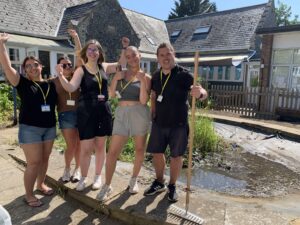


How employee volunteering can improve workplace wellbeing and employee health
By Dewi Thomas, CEO, Employee Volunteering
What role does work really play in our health?
Each year, the World Health Organization marks World Health Day on 7 April, the day the organisation was formally established in 1948 . It’s a useful moment to reflect on what really shapes our health.
We often think about health in terms of lifestyle or access to healthcare. But for many of us, a large part of how we feel day to day is shaped at work.
Over the course of a working life, that adds up to more than 85,000 hours.
So the question isn’t whether work impacts health, it clearly does. The more interesting question is: what is it about work that can make the biggest on our health?
Why workplace wellbeing is about more than policies
Most organisations now have some form of workplace wellbeing support in place. Policies, benefits, employee assistance programmes, wellbeing initiatives all play an important role in setting a direction and signalling corporate culture.
But they don’t fully define how people actually experience work. What matters just as much is what happens day to day, for example:
- how people are managed
- how teams interact
- whether people feel supported
- whether they feel part of something
These everyday factors shape how work feels, and what each of us experiences has a direct impact on our mental and physical health.
Studies reinforce this, showing that our managers have a greater impact on employee mental health than doctors or therapists, with 69% of employees identifying their manager as the single biggest influence on their wellbeing (Forbes, 2024).
Which brings the focus back to something very practical.
Workplace wellbeing is not just about what organisations offer. It’s also about how work is experienced.
The growing workplace connection challenge
If we think about how work really feels day to day, one thing stands out pretty quickly: connection.
It shapes more than we sometimes realise, from how supported we feel, to how we deal with pressure, to whether we feel included or slightly on the outside. And that feeds directly into our health.
The data backs up what many of us will already recognise.
- 43% of employees report feeling disconnected from colleagues (British Red Cross, 2024)
- Around 1 in 5 employees say they feel lonely often or always (Mental Health UK, 2024)
This isn’t just an engagement issue, increasingly it’s becoming recognised as a health issue.
Working patterns have played their part. Hybrid and remote working have brought a lot of positives, but they’ve also changed how those everyday moments of connection happen. The quick conversations, shared experiences and sense of being part of something don’t just happen in the same way anymore.
This means that connection now has to be created more deliberately. And for many organisations, that remains a challenge.
Where employee volunteering can make a difference
This is where employee volunteering can play a powerful role.
Research from the Oxford Wellbeing Research Centre (2025), based on tens of thousands of UK employees, found that volunteering was the only workplace activity consistently associated with improved wellbeing outcomes.
That is a significant finding. It suggests that shared experiences, contribution and connection are not just “nice to have”, but are central to how people feel at work.
Employee volunteering creates those experiences in a very practical way. It gives people the opportunity to:
- step out of their usual routine
- work alongside colleagues in a different context
- contribute to something meaningful
- build relationships in a more natural way
And those experiences carry back into the working day.
5 practical ways employee volunteering improves how work feels
For organisations looking to strengthen wellbeing, employee volunteering tends to work in ways that are simple but often overlooked.
1. It brings your people together
Most working days follow a familiar rhythm – meetings, video calls, emails, deadlines.
Volunteering interrupts that in a positive way.
Whether it’s a team working together with a local school, supporting a community project, or taking part in a facilitated session, people interact differently. Conversations open up, people see each other in a new light, and something more natural starts to build.
Those are the moments that tend to build connections across your employees.
2. It reduces isolation
Loneliness at work isn’t always obvious, but it’s there in the background for many people.
Volunteering creates a simple reason to spend time with others in a different context. That might be a small group supporting a charity, or colleagues joining a virtual session from different locations.
It’s not forced interaction, it’s shared activity. And that often makes all the difference.
3. Purpose becomes visible
A lot of work can feel abstract, outcomes are long-term or hard to see day to day.
Volunteering delivers real impact, immediately.
Whether someone is mentoring, sharing their skills, or helping deliver something tangible for a community organisation, the impact is clearer. People can see what they’ve contributed and why it matters.
That tends to carry back into how they feel about themselves and their work more broadly.
4. It creates space to step back
Work can be intense, and it’s easy to stay at the same pace and mindset for long periods.
Spending time doing something different, whether that’s outdoors, hands-on, or focused on supporting others, creates a natural pause.
People often come back with more perspective, more energy, and a clearer head. It’s not a formal intervention, but it can have a noticeable effect.
5. It brings workplace culture to life
Corporate culture is often talked about in quite abstract terms.
Volunteering makes it tangible. When people spend time together outside their usual roles, hierarchies soften, conversations become more open, and trust builds more quickly. You see different sides of people, and relationships shift.
Over time, those experiences shape how teams work together day to day.
How to make employee volunteering really work for your people
Not all volunteering programmes deliver the same impact. In our experience the ones that make the biggest difference tend to share a few key characteristics.
Built around how people actually work
We see participation dip when programmes don’t align with how people actually work, not how we might like them to.
At Employee Volunteering, we build programmes to fit the reality of modern working life. Different locations, different roles, different working patterns.
In practice, that means:
- A blend of in-person and virtual opportunities, so people can take part wherever they are
- Options for both team-based and individual participation, recognising that not everyone engages in the same way
- Flexible formats that fit around working schedules, from facilitated team days to shorter, more accessible sessions
We’ve found that when programmes are designed this way, participation broadens. It’s not just the same group of people getting involved, more of the workforce can take part.
Over time, that consistency is what builds connection and makes a meaningful difference to how people experience work.
Structured and supported, from start to finish
The corporate volunteering programmes that really land are not left to chance. They are carefully structured, actively supported and professionally delivered.
In practice, that means:
- Experienced facilitators lead every session, guiding the experience and making sure everyone feels included, confident and able to contribute
- Clear structure from start to finish, so people know what they’re doing and why it matters
- Activities designed for mixed groups, so everyone can take part, regardless of role, background or experience
- A safe and well-managed environment, where both employees and community partners are properly supported
That combination changes the experience completely. People engage more quickly, contribute more fully, and get far more from the time they spend together. It’s not just something they take part in, it’s something they want to do again.
Designed for each organisation, never off the shelf
In our experience, the programmes that gain real traction are the ones built around the organisation itself, not adapted from a standard model.
At Employee Volunteering, everything we deliver is designed from the ground up. That starts with understanding how each organisation works in practice, where people are based, what matters to them, and what will actually engage them.
In reality, that means:
- Shaping activity around local context, so teams in different locations are supporting communities in ways that are relevant and needed
- Offering a mix of formats that reflect how people work today, from facilitated team experiences to skills-based projects and flexible online opportunities
- Building around employee interests, so participation is driven by genuine engagement, not obligation
We’ve found that this level of customisation is what changes participation. People don’t just take part once, they come back.
And more importantly, the experience feels meaningful, not generic. That’s what allows it to carry through into how people feel about their work more broadly.
Rooted in real community need, not created for convenience
Volunteering only works when it is genuinely useful. At Employee Volunteering, we don’t start with activities, we start with need.
Over the past 20 years, we’ve built long-term partnerships with hundreds of charities and community organisations. Many of these relationships have developed over years, because partners trust us to deliver support that is well organised, respectful of their time, and genuinely helpful.
In practice, that means:
- Working with trusted charity partners to understand what support is actually needed, not what’s easiest to organise
- Designing activities that add real value, whether that’s hands-on support, skills-based projects or longer-term contributions
- Managing the experience end to end, so hosting volunteers doesn’t create additional pressure for the organisations involved
Our facilitators play a key role here. They ensure everything runs smoothly, so the focus stays on meaningful contribution rather than coordination.
We’ve found that when the need is clear, the experience changes. People engage more deeply, and the impact is felt on both sides.
That’s what turns a well-intentioned activity into something that genuinely matters.
Supported by the right infrastructure
In our experience, even the best-designed programmes fall short if they’re hard to access or difficult to manage. Making participation easy is what turns good intent into consistent engagement.
At Employee Volunteering, we’ve built our approach around that. Our specialist platform, the Volunteering Hub, brings everything into one place so employees can easily find opportunities, sign up and take part in a way that fits around their working day.
In practice, that means:
- Clear, accessible opportunities that people can quickly understand and choose
- Simple sign-up and participation journeys, whether it’s a team event, a skills-based project or a shorter online session
- Real-time visibility of activity and impact, from participation levels through to hours contributed and feedback
We’ve found that when access is straightforward, participation increases naturally. People don’t need to be persuaded, they can simply get involved.
And for organisations, that visibility matters just as much. It makes programmes easier to manage, easier to scale, and far easier to evidence when it comes to reporting and long-term impact.
That’s what allows volunteering to become part of how work happens, rather than something that sits on the side.
The business case for investing in employee health
We’re starting to see a much clearer link between employee health and business performance. When people feel connected at work, you can see it in how things get done.
Analysis highlighted by the World Economic Forum (2025) shows that organisations can see a return of between $2.73 and $6 for every $1 invested in employee wellbeing.
The return comes from very practical outcomes:
- fewer sick days
- more consistent focus and productivity
- stronger retention, reducing the cost of replacing experienced people
Healthier, more connected employees are more engaged, collaborate more effectively, and are more likely to stay. And this is where corporate volunteering becomes commercially relevant. When it’s part of how work happens, it builds connection and supports employee health in a way that traditional initiatives often cannot.
A smart way to boost employee health at work
World Health Day is a useful moment to reflect on workplace wellbeing and employee health.
Improving employee health does not always require new initiatives. It can come from making better use of the time people already spend at work.
Employee volunteering offers a practical way to do that.
Are you creating enough opportunities at work for people to genuinely connect, contribute and feel part of something?
And if not, what could you change to make that part of everyday working life?
FAQs
What is corporate volunteering and how does it work?
Corporate volunteering is when employees are given opportunities to contribute their time and skills to support community organisations, usually during working hours. Programmes can include team volunteering days, skills-based projects, and virtual or micro-volunteering opportunities. The most effective approaches are structured and supported, making it easy for employees to take part while delivering meaningful impact for communities.
How can companies design an effective corporate volunteering programme?
An effective corporate volunteering programme is designed around how people actually work and what communities genuinely need. That means offering a mix of in-person and virtual opportunities, ensuring activities are well-organised and supported, and making participation easy and accessible for all employees. The most successful programmes are not one-off events but consistent, structured experiences that build connection, support employee wellbeing, and deliver measurable impact over time.
How does employee volunteering improve workplace wellbeing?
Employee volunteering improves workplace wellbeing by creating opportunities for connection, purpose and shared experience. It helps reduce feelings of isolation, strengthens relationships across teams, and gives employees a sense of contribution beyond their day-to-day role. Research from the Oxford Wellbeing Research Centre shows that volunteering is one of the few workplace activities consistently linked to improved employee wellbeing outcomes (2025).
What are the business benefits of corporate volunteering programmes?
Corporate volunteering programmes support employee engagement, retention and productivity. When employees feel more connected and purposeful, they are more likely to stay and perform at a higher level. Organisations also benefit from stronger employer brand, improved social value outcomes, and clearer reporting for ESG and procurement requirements. When programmes are well-designed and consistently delivered, they can become a practical driver of both employee health and business performance.